Tubes…

Tube amps are cool
Been a while huh? I’ve been busy tidying up mostly but a few things have been occuring. Tidying ’cause the inorganic is this weekend and it’s forced me to go through all the tube stuff and I thought it’s high time I built a tube amp.

This one is a combination of a radio chassis I picked up from Ben at Radio Specialties at the top of Upper Queen St, who still has the odd treasure stashed away, and the output tubes and output transformers from an ol’ akai reel to reel given to me by Johnny Pain of the now defunct Halleluoya (phonetic see) Picasso’s.

The radio chassis had one 6AV6 tube left in it, all the other tubes gone, and a power transformer that were of use to me. The 6AV6 is basically half a 12AX7 in a 7pin so they are somewhat overlooked and NOS they can be bought cheaply and will sing just like the ol’ vintage 12AX7’s which can be very expensive. The output tube is a 6BM8 and these feature a voltage amp triode, somewhere between a 12AX7 and a 12AT7, and an output pentode, the english is the ECL82 (E for 6volt filaments, C for a triode VA, and L for output pentode) and one worth looking for is the PCL82 which is a TV tube with 16V filaments. Two PCL82’s and you’ve got a stereo amp for almost nothing. Actually two PCL82’s and a suitable class AB1 output transformer and you’ve got a very decent small guitar amp. Add in a few bs109 mosfets, small signal mosfets that’ll take 400V max on the drain, and you’ve got a very cheap way to get a cutting edge amp that’d fool even the purists.

So my little amp will have the 6AV6 doing the first stage then have a IRF820 mosfet as a source follower into the tone stack, which is a very interesting almost parametric style thingy I got at AX84.com, then into the triode of the 6BM8 then output pentode in class A, single ended. The rason for the source follower is that the plate, or anode, of the 6AV6 wants to see a high impedance to get the most of it’s ability to make big voltage swings but the tone stack requires being driven from a fairly low impedance so the obvious thing to do is to chuck in a cathode follower or even better a source follower using a mosfet. A cathode follower using a tube allows a little bit of tube tone shaping as the tube follows the voltage on the grid with extra current from the cathode so you get a little extra harmonic content as the tube hits its edges of available current and voltage but a msfet source follower is cheap to impliment, takes up far less room, and as long as it isn’t hitting it’s rails then the difference is unnoticable. Doing the same thing in a marshall amp would have consequences as the tone stack is after a whole bunch of voltage amps that crunch into the rails. This one won’t and any distortion I do get will be from the OT and the pentode hittings it’s rails.

As well as this I’ve also got the parts and drawn up a PCB to do the Boss slow gear. This is a pedal that allows one to emulate the ol’ volume swell so the initial attack disappears and the note played swells out of nothing. Simpllish type circuit that may need tweakin’ and depends alot on the jfet chosen to effect the signal through. Based on the schematic at BYOC, build your own clone, pedals.
You get all the info to do it in the instruction .pdf
I designed my own PCB though

Funny thing, I performed at Vit S the other night and most of my gear didn’t work but I was playing a guitar normally and through a homemade delay and a small tube amp with 2 x 12″ speaker cab and I finally got some kudos from other gear head Rohan. I’ve used the tube amp and cab before but with oscillators… funny how it may have been the more familiar sounds, wound pickups under nickel wound strings, that had his ears perking up!

Analog, digital, tubes, strings, oscillators, whatever! If it sounds good then it is good. I hadn’t thought about the concept that these prejudices might actually stop people from actually hearing things. Given we’re going into an mp3 world then the prejudices are even sillier.

Blabba dubba do!

Sorry about yesterdays post. Thats what happens when you wake up and read theoretical textbooks about music first thing in the morning.
But I had a great day!

Got rung quite early to go pick up some ordered stuff at RS components and this put me in Penrose with money in my pocket so I decided to go searching through metal salvage yards. Coupla years ago you weren’t allowed near them, ’cause of osh I suppose, but I’d forgotten that and went looking anyways and was allowed free scuttling about in all I found.

I saw a percussion thingie at the Rock shop a day or two ago and it was so simple I decided I want’d one. Basically it was a compression spring about 350mm long at maybe 30mm diameter with the spring itself being about 3-4mm thick and this was welded, at one end, to a metal bowl of a half sphere shape and the instrument was held on the stomach at the junction of the spring and bowl and then the spring was struck and skritched, ala guiero etc, and the bowl lifted and lowered from the body.

Sounded TREMENDOUS!

So bloody simple and easily made it set off a whole bunch of ideas about using springs and resonators. It’s basically the same concept as the jew harp which uses a spring vibrating, but more of a tine, and the space in the mouth, the bowl, to modulate the sound.

A spring, of spring steel, is inherently sound able as the steel has an internal rigidity, structurally, that allows applied force to be counteracted upon while at the same time being malleable. Guitar strings are actually made with spring steels for this reason for their resistance to stretch compared with other steels.

But this instrument doesn’t need to be spring steel so much as it has to follow the shape given a spring. A length of mild steel wire wound around a former to make something resembling a spring will do the job just as well. Not quite as well, but within degrees of separation that wouldn’t matter unless you were in a laboratory. I say that because compression springs of the size required are something of a rarity though I did find one by stopping in at a motorcycle mechanics shop which is a veritable rats nest of spare parts and asking for a fork tube spring. The point is that spring steel isn’t needed and mild steel will do the job if you don’t plan on sitting on the finished article.

Anyways I ended up with some 75mm aluminium tube at lengths very suitable for air tuned tubes either as big flutes or used under marimba type bars. I’m kinda also looking at thumb piano’s and marimbas lately so flat and round straight lengths of spring steel were also part of my searching. I think with scavenging the idea is not so much to be looking for anything in particular but to have lots of ideas about the endless possibles and then rummaging about and seeing what strikes ones fancy. At one place, which was an absolute messy and dangerous hole ( I loved it!) I came accross this.
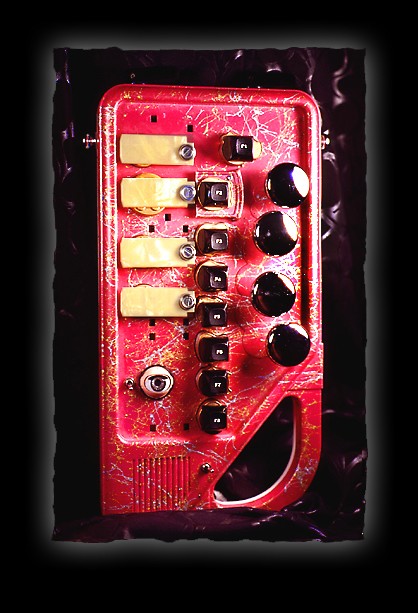
It Goes!
Plugged it in and it goes. I gave them ten bucks but could have got it for much less but when perusing places like these I reckon it’s best to give people more than less on the simple assumption that people are more llikely to enjoy the company of givers as opposed to takers.
Its going to be my first circuit bend project. If you don’t know about circuit bending then this is a nice bit of reading
The man himself can be found here but he doesn’t give much away.
I also managed to find a bunch of Toa compression drivers for $15 each, that came from the old Rugby stadium in Kingsland, which may be used as is or broken down for use as talkboxes and use the shell as forms of acoustic radiators… who knows!
The whole caboodle
This is the bunch of stuff I managed to bring home. I’ve kinda been looking for a big saw, spring steel again as it happens, as I know how to bow them to play them and I’ve had in the back of my mind making a holder or frame to better get the vibrations from the saw and also make the tuning easier with a lever mechanisn to hold the head or top of the saw. The big pot and dish are obvious candidates for resonaters and then theres the springs.
springssss
Top right is a fraction of an expansion spring about 700mm unstretched and I’ve been thinking about doing my version of Phil Dadsons number one tool, a string on a drumhead, and this spring stretched out could be quite interesting.

Phils stuff revolves a drumhead sitting on its body then two rods go up from each side of the drum body to a point where a string is attached. The other end of the string is attached to the drumhead. Basically the two rods can be pulled together and this lowers the stretched strings pitch. Phil has two versions I’ve seen, one about 1200mm long and the other about 1500mm long which is a newer one, and he makes some absolutely amazing noises with them, bowed, plucked and rubbed plus using the drumhead percussively. I want to get rid of the drumhead as a resonator and use a resonator similar to the dish in the photo of all the stuff, lower middle, and have another dish hingeing off its edge to control the enclosed airs area alike the mouth cavity used with a jews harp or the african talking drum. At the other end of the stretched spring I’d have a mechanism to allow me to stretch the spring length and raise the pitch with a lever of some sort so with the rods going to this point I could lower the pitch and then using the lever raise the pitch. Springs sounds more like square waves so it’ll be more a noise intrument than a single string harmony instrument.

The other spring is the motorcycle fork spring and the bunch of little ones will be used on a plate reverb ala Bsidebeats.

very interesting
And these contraptions are gearheads used in gas bottles to show the capacity. They are totally mechanical with the arm working the gear and the shaft driving a gauge. I want to use them to drive pots somehow. The gearing is such that a full turn of a pot, about 320 degrees, can be actioned with about 170 degrees.

I’ve actually had a few weeks off from instrument making and performing at Vit S but with getting th Bart Hopkins book from the library I’m well back into it.
The books called Musical Instrument Design.
You Videohogs might like this page
I haven’t looked but it might be interesting. Sometimes super nerds have the blessing of also being great speakers.
The other Bart!

Update; Just and equal.

stuffs
Are the two the same? Maybe they are, maybe they aren’t. As regards intonation and temperment they are different enough to have been almost forgotten.

Basically it’s about just intonation and equal temperment as methods to acheive scale intervals in music making.

The basic story involves the fact that before the 17th century or so, when the need to be able to modulate between different keys came into being, most musicical instrument were tuned using just intonation which means they were tuned to a specific key and basically sounded crap if you tried to play them in another key. The reason for this is that the intervals between a root note and it’s octave were dependant on fractions. Well not fractions so much as whole number relationships.
These relationships were arrived at by trial and error and when measured came out to be numerical. But those relationships or intervals change slightly when you decide to use any of those notes between the root and octave as a new root, or key centre, it starts to sound wrong.

Now this all might sound rather silly but I had occasion to play with a pianist years ago, the piano is the main advocate of equal temperment, and was told by this pianist that I was playing out of tune. The thing is that guitarists tend to compensate away from equal temperment by kinda tuning to specific keys then allowing small stretches here and there to bring the notes into just intonation evn with the fact that guitar frets are put together in equal temperment. Pianists and keyboard players can’t do this so their ear is taught to accept the notes they hear, from the keyboard, as the right ones. They are if you only understand equal temperment. One of the best instances I know of is listening to songs in Am or E that have brass in them and the brass often sounds off. Thats because the brass is tuned to Bb and that shows up when the guitarists do their stuff in Am or E. The brass always sounds a little flat.

Kinda interesting stuff and even though its a bit less than a slight nigle muscally I think it’s an interesting metaphor in the growth of civilisation, western anyways. Wikipedia has some interesting articles on it and the only people outside of piano tuners who will know what your talking about are mathematicians.
Now add to this the simple fact that sound through air moves faster or slower depending on the air pressure and that our ears don’t really compensate for this then we have the simple fact added in that even tuning consistently is a rather difficult and imprecise art.

Recently I watched a neil young and crazy horse video by Jim Jara something or other, and they had ceded in a modern version of “like a hurricane” with a version twenty years older and I happened to be playing along with it while this occurred. I had to retune because it was about an 1/8 or so out. Then I was surprised later on when in the extras the boys were talking about it and mentioned they were amazed that the two versions were in tune. I’m like what? Are they just joking to cover an obvious discrepancy or are they telling their own literal truth? The videos called “The Year of the Horse”

Amps

I went and bought a bunch of IC amps yesterday after seeing a friends little pignose and having someone else wanting an amp for their own Vit S use. I’ve been thinking about something I can make that’ll add art and convenience together to sell on trade me and ebay to keep the engine of my yearnings supplied with the oils of commerce. So I think I’ll make some little amps that are powered by adapters. Maybe even have a psuedo busking cum tiny venue thing without allusions to practice, as it were, amps. Mic inputs, dynamic and piezo, high impedance, guitars, and a little mixer and effects loop all put together in a hand made box and sold as an artwork.

Might work or it might just be another stupid way of making something that does the job intended really well but takes far too much time and effort and just becomes too expensive. I think the idea will be to lift its aesthetic above the mundane that fills music shops and even above boutique market by making it sing with art.
KInda like this I suppose
I love the idea of being able to sell something that has ten dollars worth of IC’s in it for 300-500.00 bucks.