An Amp for all seasons.

Theres a coupla guys at vitamin S…, well let me start again, the vitamin S thing kind of requires, at times, using orthodox stuff for unorthodox things. That means that conventional gear hooked up to acheive relatively simple tasks can end up being rather cumbersome. Two guys at Vit S have needs of an amp at the moment, one being Tom who at the moment has a pignose amp, and has to unplug his keyboards to then play his piezo’d thumb piano… but he also wants to go busking sometimes. The other guy is Ivan who wants to move into amplification from purely acoustic with his percussion stuff but also wants to get into looping using digital loopers.

In both instances you either need a bunch of conventional gear which costs alot to be any good and can end up being rather bulky and somewhat expensive so what I’ve done, while also thinking of my own need to have a simple amp to test my own fx and instruments, is to come up with this.
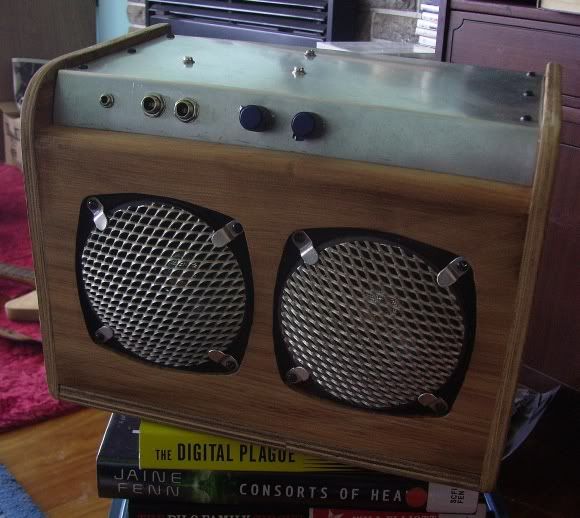
PI - PO - GI Ruby.
It’s based on a LM386n-4 amp IC which puts out about .5- 1W of audio power. The schematic I used has been developed for bedroom guitar stuff and is called the Ruby. I added a piezo amp to it so to the far left is the 3.5mm piezo input then the 6.5mm piezo out then the Ruby in. Basically I didn’t hard wire the piezo in so an effects chain, or mixer etc, can be put between the piezo preamp out and the ruby in. If nothing is plugged into the 6.5’s then the piezo goes direct to the Ruby. What I’m going to add is a mix control, and I don’t have any idea at the moment how to do this, so that the piezo preamp can be mixed with an input into the Ruby… so as a busking amp you could play a melody instrument while also having a beat being made with the piezo… or whatever piezo’d up. Given the piezo preamp is simply a high impedance input, 10Meg, it would also work with carbon mics like those used in old CB radios and harmonica mics.
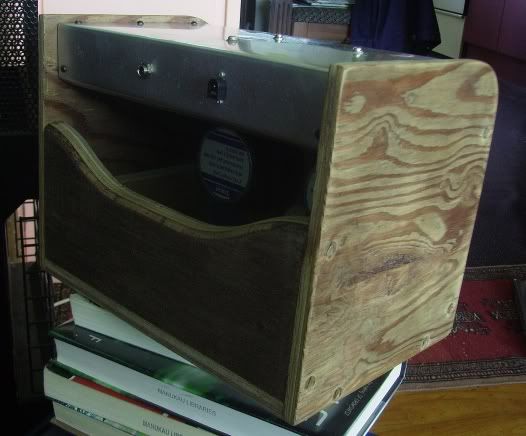
power in and out? Yeah!
At the back it’s got a 12VAC input, I found a plugpack at the Glen Innes Sally Anne shop for 5 bucks, to power it all and to the left is a 9VDC out so FX etc can be powered up as well. Now things get tricky, not so much that the amp itself doesn’t work fine the way it is, but I realised that I could also have it all run on a 12V sealed lead acid battery so it could be used anywhere and anytime without having a wall with 230VAC in it. If I had’ve used a 12VDC plug pack then it would been easy enough to just wire up the battery off the 12V in jack and switch the earth on the input for the Ruby like any conventional Fx unit but I didn’t use DC but AC but thats alright because batteries are rechargable and the nifty thing with the pignose, and a CD player I had once, is that you can use a AC input to drive the amp, by rectifying it, or charge batteries given the right circuit between the AC and the type of rechargable battery your using. Usually it’s just rectifiction, to cut the negative going pulses, then a form of limiting so a depleted batteries low internal resistance just doesn’t suck a bunch of current and overheat and blowup! That, too, is why AC is better than DC for rechargables because the rising and falling AC current gives the batteries a little rest every 1/20th of a second at 50Hz line frequency.

Good Golly, then I decided I could also put a bigger amp in there, the speakers are 2 x 8 ohms @ 10W each, in series, so I’ve got 16 ohms @ 20W headroom for a 1W amp. The box is pretty big so I could easily fit a sealed lead acid battery and a transformer in there and use a 10 -15W car stereo IC like a TDA2030 and have a switch on the output of the Ruby to change it to a voltage amp. Basically it’s a busking 1W take anywhere thing then flick a switch and plug it into the wall for lots of watts and distortion aplenty.
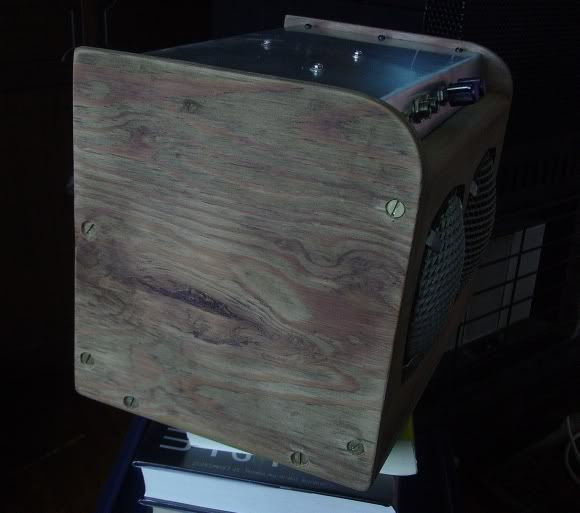
Old plywood and brass woodscrews! Lovely.
I just love packing crate plywood which always seems to use the shittiest, grainiest offcuts that can be found and glued together with utter abandon… and brass woodscrews.
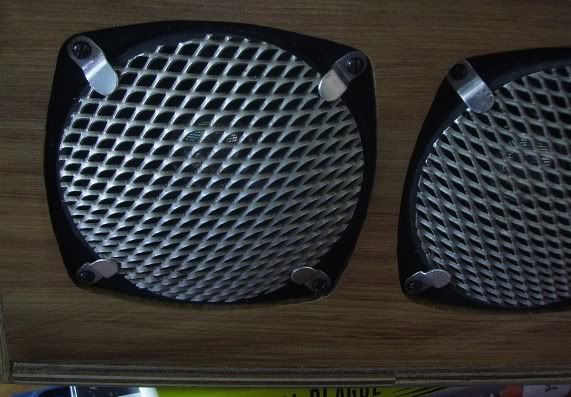
I'm cheap... I know.
Does it sound any good? Actually it does, especially with the acoustic guitar when it feedbacks like a Rhino on heat, very usable sounds. It could do with a tweeter of some description because the speakers are 4″ mid/woofers so they bring in the lows and mids well enough but it’s a little lacking in the highs. Maybe one of those new age ultra fangled ribbon tweeters from jaycar. I’ve been wanting to get one to see whether they can be used as microphones.

Oh, and the alloy top rattles like crazy because its too light so I either add mass to it, the easiest option, or I rubber mount it… which might stop it but more likely just narrow the frequency band it vibrates at.

So I’m quite pleased with myself with this one and also intrigued by a bunch of design questions to take it further. Other peoples problems can be a beneficial source of inspiration.

Helpin’ out, here and there.

Some of these young chaps out there in Netland, and especially the DIY effects community, seem to appreciate my way of making a printed circuit board. It seems my pen and paper approach hearkens back to the early effects of the seventies for a few of them and this nostalgic kinda feel I seem to be able to get has a few of them. at the moment, asking me to design layouts for them. So I have.
the okko diablo
This ones the Okko Diablo which seems to be a nutso version of the BRIASB, or something like that (actually BSIAB 2 “brown sound in a box“), which features cascoded, I think thats what the configuration is called, fets, or is it SRPP? Something anyways that started back in tubes and has found uses in modern effects. The bottom fet voltage amplifies and the top fet current amplifies so it’s the best of both worlds I suppose. This circuit has been tweaked and pushed to the limits of oscillation I would suppose and may be quite the scary animal. 2N5457’s, mpf102’s or J201’s would be the most likely candidates.the blow ups here
Heres the original schematic (you might have to join freestompboxes though)

Then we have a young chap whos built an amp from various IC’s again to kinda emulate tube amp stages, and quite fancies my layouts for his own stuff… so did I have. Discrete fets as above and then the IC’s moving from left to far right are a TL072, an LM386 and then the amp IC LM1519C… 12V for the preamp and 16V for the big amp which would need at least 2A of current.
Brymus's amp
link to photobucket here

Handmade02

So just as you pass the counter this is what you’ll see. A set of steps goin’ up.
steps
Then when you get to the top of the steps…
in daylight
So it’s definitely going to be a reverby space with a resonant frequency that stands out above the rest but where that position is and how big it is will only be found out once music fills the space. My thinking is that it’ll be quite good to perform in and quite good for the people close to the performance but I think it’ll degrade pretty quickly after that with a lot of clear highs lost as the close walls start bouncing the standing waves. But oh well, first in first served.

Does look good though doesn’t it?

Handmade; the Venue.

About a week and a half ago I had a word to one of the Pauls at Vitamin about the possibiliy of having Vitamin S support some shows at The old Brazil coffee shop on K Rd. Yesterday I went and saw Eddie at what is now called Handmade, number one to sell him a longboard skate board which he did actually buy so I could exist for another few days, and number two to enquire about doing some shows upstairs on something like a wednesday night. I also happened to have a new instrument in the car, a long spring attached to a potty basin thing of sorts, not as in potty for poohs and wees, but as in somewhat like a pot; having pot type associations… and he liked it and agreed , in principal to me setting something up.

When I was talking to Paul he suggested an acoustic set and I’m like nah, to myself because I’ve got to get this thing off the ground, because in my head I have an idea of having a backing group of musicians who work up , well, a background maybe with a emphasis on loopers… the rock steady beat equivalent in the improvisational world.

Theres two other people I’d especially like for this task so the three of us would be the mainstay but over that, and under it as well, I’d like to invite in soloists to add there stuff. Maybe one extra backing musician to set the scene for the backing and then a featured soloist to take up front duties as it were.

I’d like most to have my friend Felix Deuxe up from Raglan each week or fortnight simply because hes an absolutely great musician and two because he is adept at making his own instruments, both acoustically and electronically.
bsidebeats

And the other guy I don’t even know the name of but he’s been at Vit S a few times and I really like how he works. I’ll track him down somehow and the fact that he wears a hat, of a style currently in vogue, made of grass but not hippy or Islander church, that is reminiscent of the 40’s and that hes quite tall and lanky should make it a done deal.

I’d also like Ivan for backing duties, whom I visited yesterday afternoon, but forgot to ask about this. Ivan too, has been quite the made in the shed man so that will also go along with the handmade thing I’m hoping for. It’s not so much that everybody who plays will have to make their own instruments, but it’d be nice if that were to occur, but more that the general approach to music making has a quality to it that is more like mining for minerals and precious metals. In the sense that the instruments themselves aren’t something that is sought to be mastered but that they are merely tools to make sounds.

I kinda see two seams or approaches coming through at Vit S and one is people who always use the same instrument and work to always redefine and rework the palate of that instrument and the other approach which seems to be less about particular instruments and more about having the instruments help to define an approach. This isn’t tried and true as a categorisation and if anything it only serves as the loosest of definitions but to the latter group, who kinda stand in front of the instrument, I’d like work with these people to draw this approach into something more than a vague definition and give it a little more space to move.

And though I very much enjoy the free improvisation of Vit S I’ve always been a bit of a popster who enjoys beat and melody so I’d also envisage that this adhoc assemblage of music makers might find that area between common modes of practise to entice an audience, hooks and grooves, and the ethereal spaces of free improv which hint at a deeper unfurling of consciousness. This is not to say that sets would follow any constraints at all, alike a chord chart or written sequencing, but that the players might choose to drop into a groove and allow themselves to follow it. Deepest Africa meets deepest Europe maybe.

Anyways, Paul and Eddie are keen so now it’s up to me to formalise something and I’d give myself a month to get something together complete with my signature totally…um whats the word? Can’t think of it but it’s a way of advertising thats starts with hints and works its way up to the passing of straight forward information. Like teasing I suppose but its more enticing, or works to entice through making a game of guessing what its leading to.

On a completely different note I met a plumber named Pete at Ivans yesterday and he put me onto something called silbralloy which is a 2% silver brazing rod for copper which is significantly cheaper than using silphos (up around 12-13 bucks a rod at 15% silver content). I’ve got two ends off some hot water cylinders, which I actually got from Josh of the old Odeon, when he got a bunch of cylinders to top the bar with copper. He cut off the ends and just used the cylinder itself after flattening it out so lucky me has has a set of ends sitting about waiting to be used for a few years now. I spent a few hours yesterday hammering them into shape on a sandbay with a wooden mallet and later today I’ll get the dollies and planishing hammers out to get them into a more lustrous shape then I’m going to do a handrum similar to the one Ivan made from a gas cylinder though I’ve got a few extra ideas going around my head about what else I can do with it. A little Carribean, thats not spelled right, tone shaping in the tin drum style with raised areas defining notes but also some tuned length tubes here and there.

I’m off into town again today and I’ll get some photos of the Handmade space and also get some of the new instrument and the coppers. The other thing I really wanna do is get all my effets into one box so the scattering of individual boxes I’ve been living with is contained in one area with about 42 knobs!

Humanity through the unused organ of… organs.

I may have written about pulling apart organs in the past but today I pulled apart the oldest electronic one I had and through the progression of the ones I have demo’d, as in demolished, I’ve ended up learning far more about humanity and our relationship with technologies than I’d ever care to know.

The first one was an italian job from the seventies, late I’d surmise from the chips used, and this one was on the side of the road with the amp and power supply already cut out so just removing the keys and associated electronics for salvage made this one easy to rip apart. I mean there wasn’t really much incentive to rebuild it into something because the research would’ve been too much to find out what was missing. Or at least that was the excuse I gave myself as I mined it for the rare IC’s like LM13600 and LM13700’s. One really needs to understand the architecture of these things to understand whats going on and the more electronic they are the harder they are, without schematics, to understand whats going on.

Then, in quick succession I pulled apart a Baldwin funmachine and a crossover era Hammond. These were both of a style where the tone generation is done in specific monolithic, meaning big I suppose, chips whereas the Italian job was more old school in that alot of the functions were fulfilled by groups of discrete components. But I did get a little further along in understanding the architecture the organ makers used. Suffice to say these two examples still had a pile of usable wire, caps, transistors and springs, screws, grommets etc that are of great interest to anyone contemplating the building of instruments.

But today I got into the big old Gulbransen from the early sixties or late fifties though I’m pretty sure it was the 60’s as it had transistors and tubes. I basically got it not working for the tube amp simply because output transformers and power transformers are hard to get these days. Not so hard if one lives in America but these babies are heavy so they are expensive to ship.

Anyways, the tube amp aside, this thing was an absolute wonder to pull apart. The architecture was obvious as most of the signal logic was mechanical and the things they did to acheive switching etc could never be done today unless we had budgets akin to Nasa.

The way these babies work is by having a whole bunch of tone generators. Each note has about 8-9 octaves on its board and the various stops, what they call the instrument or sound choices, switch in the base note plus various other notes, at specific amplitudes below the level of the base note, as harmonics plus maybe some pink or white noise on attack or sustain. So you’ve got about about 24 notes, or two octaves, of base notes and each note is replicated in octaves up about 8 times which gives you about 200 notes to combine in different ways to acheive the sound you want. The mechanical setups to acheive this are such that I would work my whole life to build just one organ and need a really comprehensive workshop of machines to acheive this.

You can look at your average Casio that you can buy at the shop tomorrow and upon opening it up theres almost no mechanical action and even where there is its all been autocadded so we can’t draw any real connection between ourselves and our abilities and view this casio as something we could contemplate building. But the Gulbransen from the 60’s could be made in the workshop out back. Given the Raw materials were available, and they mostly still are, and the basic discretes like transistors and caps and resistors were also available, which they still are, then 90% of the work to build the Gulbransen could be done in a backyard workshop… but it would take years to do for one person!

(Okay, it’s been a week or two since I wrote the above, so I’ll quickly sum it up and publish so I can get onto other things I have or haven’t been doing.)

I suppose what came accross in this spasm of demo’ing was that the people of earlier generations had so much better stuff than we had. Even the sh#t stuff was almost exclusively handmade and the materials used were closer to their raw state and I can’t help thinking, I’ve seen it in artworks and preloved antiques etc, that that human element combined with the rawness of the materials ended up with things that have ended up being able to last a long time and even be rebuilt over and over. Even if we stop loving the stuff for it’s anachronistic behaviours it still seems to retain a semblance of determination to last and I think that may come down to the underlying hopes that were built into things.

Now the machines just spit things out and the labour forces are hankering for what we are discovering is an empty dream as the weather shifts it’s focus and the Ice sheets drop into the Oceans.

We may think we have more options and easy ways to work our new stuff but does it have the real underlying hopefullness I think we really need.

Suffice to say I am happier with stuff made that I can replicate myself and have a chance, without many years of specialised training, of understanding that is also somewhat dangerous and unheeding of my ignorance… than I am of using and enjoying something that is so beyond my capabilities as to be nothing but mystery… Except for my Boss Looper and Delay pedals.

That said I’d envisage a mix of 80% stuff that wholesome and understanbly fixable and modifiable and 20% mysterious otherworldly factory spat out super techno.

Just like my music I suppose.