Where to?

Jumpin’ off the bandwagon, that has been the building of various music related things, to do the artworks for the show, has given me a little breathing space and a chance, therefore, to review where I’m going with my instrument building.
As well, theres the fact that I’ve been going to handmade most Wednesday nights, maybe even tonight, and playing basically the same setup each time and somewhat getting my chops together using that setup of basically acoustic soundmaker into preamps then the looper (RC-2) followed, or preceded by, the delay (DD-7) and this time of really trying to dig the most out of a basically unchanging setup has got me thinking about my whole approach to instrument building.

Basically it comes down to about three catagories that I can spend time on, not including the actual performance issues but alluding to them as the primary motivation… if indeed it is the primary motivation,and they are instrument making, preamp and amp making and signal processing or effects.
Sound generation, sound modification and sound reinforcement. The sound generation can be broken down into the two categories of electronic and acoustic and to a certain extent this is the case with modification, with electronic being predominant but acoustic being somewhat more interesting, and while this is the overall breakdown the ways in which these sound articles come into being can be further broken down into the areas of mechanical and electronic by defining the working methods to bring things into being.

So an amplifier is basically electronic but its construction is mainly mechanical as it needs to be in an enclosure of some sort and this enclosure needs to be able to hold all the parts and be reliable in doing its job. The thing is I’m realising that the mechanical part of making all this stuff is, by far, of a much greater interest to me than the electronics, except for valve amps which, because of the nature of the components, is quite mechanical as regards the building thereof.

This is all to say that as I tidy up the big mess left over from creating artworks I’m thinking about, instead of launching into a bunch of circuit board etching to create more sound modifiers that don’t actually do much, I’d be far better off attending to unfinished projects of a more mechanical nature.

Last monday night I did Vitamin S with an assortment of tubes! Not vacuum tubes but real tubes as in various lengths of plastic from thick black drainage pipe that are used in under-road supply and waste, 3 lengths at 150mm x at least 2mtrs long, plus some plastic tubing that fabric sellers roll up on, 60mm dia, and some 30mm conduit for electrical supplies. I tied most of it to the roofracks on my car and took in a hammer, pliers, a few lengths of wood and a roll of wire and when I arrived I put it altogether into an instrument vaguely like those built for the from scratch ensemble all those years ago… and it was great fun!

The artwork creation has lifted my head above the musical instrument making and I’m realising that all I wanna do is have fun!

This is gonna take some thinking. Number one I want to explore more of the acoustic properties of instrument making and spend less time on the electronics and knob twiddling. I want to be more in tune with the possibilities of performance as regards the instruments and how I move around them during performance… as opposed to just sitting on my ass and leaning over things.

But, and theres always a but, there is always the compromise one needs to make with any making of things in that they all need to be transported and stored before and after use. I’ve never been worried about artworks because they either sell or I end up giving them away but these instruments put me in the region of keeping the stuff, which has never been a problem before but after a year or two of instrument making they are starting to take up quite a bit of space… And I’m realising they need to built tough to stay functioning through the vagaries of transporting and storing them from place to place.

But it’s almost midday and the money will be in the bank so this time wasting charade is almost over and I can go out into the world and buy more shit I don’t really need.

A functioning Phillips radiogram with EL86 output tubes for $66.00, and an idea for an amp that uses the radio which is mixed through a ring modulator with a high impedance signal input. Those big plate capacitors, which are the tuning dials for the radio could be replaced with a theremin type body capacitance input…

And a whip antenna at 1-3mtrs to do the VLF stuff…

Last night at the… begins with A.

Spent yesterday afternoon rehearsing a little piece with the looper, and mainly voice, but it didn’t really work so I went to the theatre in Point Chevalier for the Ten Acre Block performance, as part of something gleefully called “Original Orifice” (which, by default makes me think that a performance in future could be called Anemic Artifice…not this one but just as a name for something that explores the artiness so inherent in art performance) knowing, pretty much, I wouldn’t be performing a solo.

So I get there and find a place to set up and it’s near a power point so alls good but by the time I set up, as I start from the outside and work in so the power cords are always last, the power point I wanted is gone and the nearest available is a lighting circuit which kinda irked my but I’m never one to cause a fuss so I plugged into that. Then my pedal power supply won’t work and keeps knida dimming out the pedals. So I end up taking out the pedals, which means I definitely can’t do a solo (no looper) and fire everything and it works good… so I power down and wait for the show…

Show starts and my power disappears… The lighting circuit was dimmed. So the hint I got with the pedal power supply coming in and out should’ve had me abandoning the lighting circuit. Seems the circuit of the dimmer was working in conjunction with the switch mode supply for my pedals and creating a low frequency tremolo. All the other amps and supplies worked because they’re all transformers at 50Hz but the switch mode supplies use high frequencies to get a DC current…blah, blah, blah.

So problems with switch mode supplies means you’re on a lighting circuit with a dimmer. Anyways nights of failure aren’t a worry, success and failure being flip sides of the coin that overall means learning, and if anything the smile on ones face during success can be a big wall for learning to get over… so maybe lots of failure is good… actually its really good, mistakes are the spice for the basic ingredients of success!

So heres a pretty little circuit that allows one to hear very low frequencies. Very low magnetic waves transformed into audio frequency.
VLF
and it comes from this page
The 160mH choke can be the primary from a Jcar 1k/8 ohm output transformer just like they mention the radio shack 1k/8. As for the other mentions of chokes on the input and as a high pass filter after the 160mH choke, at 100-150mH to get rid of 50Hz hum from power lines, your on your own as they are quite difficult to get hold of as straight chokes but the 1k/8 ohm might work in those places as well.

The 2N3819 fet is used in boss pedals as the switches to bypass and can be gotten from RS but I’d think just about any audio frequency fet would do. Likewise the transitor on the end could be a BC547. The antenna is a bit of a mystery but I suppose it’s just an ordinary telescopic type at three mtrs but maybe a three mtr length of wire would do as it’s the length that counts.

Now go out into the world and listen to the ripples of remorse in the magnetosphere!

The incredible stylophone

stylo
Thanks to Felix in Raglan of bsidebeats.com I have been introduced to the stylophone. A remarkable device that has been around for years and a wee search will bring up Rolf Harris and David Bowie as famous people enamoured of its delights.

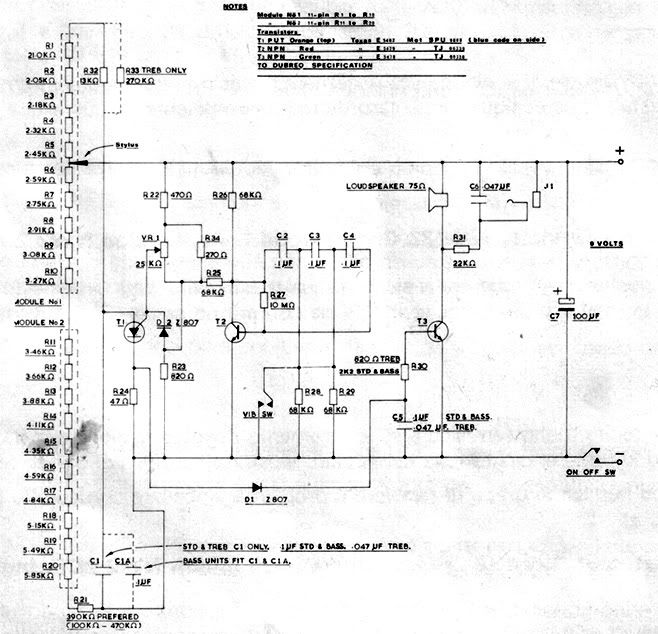
I found a schematic and I’m going to build one.
The stylophone

T1 is a BJT which is a unijunction transistor and they are available from jaycar. The two outputs from the top of what looks like a diode are B1 and B2 and from the bottom is E1 and apart from that seemingly obscure device all the rest of it is straight forward stuff. Bjt’s have long been used as oscillators… something relaxation oscillators I think… from memory, and circuits with them used as such are in a few of my old beginning in electronics books.

Basically the resistance is in parallel with a capacitance across B1 and E1 and then the output off B2 which feeds a normal oscillator of the type we know as a tremolo… oops, got it wrong.

Okay, the audio oscillator, with output at E1, is across B1 and E1 and this is modulated with the LFO at B2. D1 and D2 are signal diodes or germaniums though either should work and the amp is T3 and would be a low gain device with a high mA rated, up to a watt maybe so a little bigger than a straight signal amp but still a tiny little thing. T2, the LFO amp would be a typical voltage amp transistor like a BC549.

So while I was shown it yesterday I immediately thought it would make an interesting configuration for a beatbox and sure enough… there is a stylophone beatbox.
beatbox
This article is selling for the low price of US$21.50 and would be a bargain in any neck of the woods especially with all the luck I’ve had building drum machines… which ain’t much!

Funny how the idea I had yesterday about a drum machine version of the stylophone was based on having a round copper board and then having the stylus revolving around the circle at the speed of the drumbeat one wanted… and here it is round!
The required patchbay to change the sequences isn’t there though. Maybe I’ll suggest it to the manufacturers if I can find them.