
The little Mic Preamp works well but singers would have to do the old moving of the mic for big signals as in move the mic away when you go large and bring it in real close for whispers…. which is all well and good if the microphone is being held by someone competant in that way but can be rather nasty if sent into clipping all the time a peak goes through.
If it’s statically picking up sound pressure from a source with lots of dynamics then problems are going to occur and some form of anti logarythmic amplification is required, ie; compression.
The signal source gets louder and so the amplification goes down. One of the easiest way to acheive such things, and given I’m seriously vacant when it comes to what really can be acheived with electronics know how, is to use LED’s and LDR’s. The signal gets changed to a voltage and that lights an LED which in turn effects an LDR, which is a light dependant resistor. The LED gets bright, big signal, and the resistance through the LDR gets lower. The simplest way to do this would be to split the signal at the output of any amplifier and have the signal going out also fed through an LED and have an LDR across the volume pot so if the signal is big the LED lights and the lower resistance in the LDR across the pot brings the signal closer to ground and therefore siphons some off.
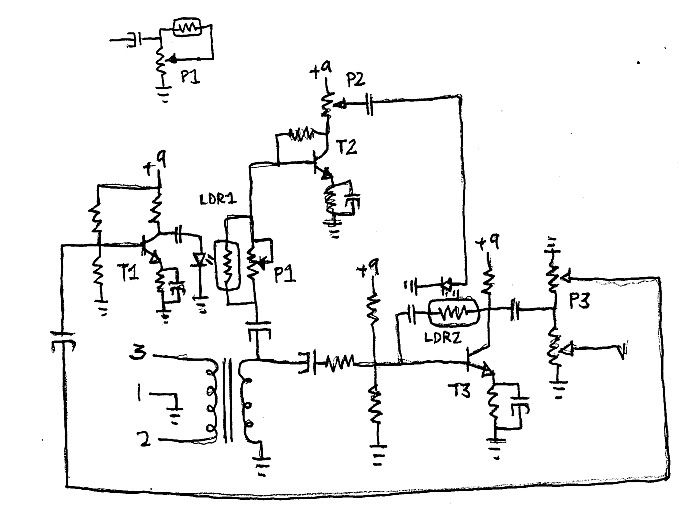
Though this is simple it is fraught with complications and would rely on having the right LED and, even harder, the right LDR which may or may not exist. So what we do is add an ability to taper those effects to our needs and this is what I’ll try to do with the schematic below.
Basically you set P1 and P2 so that low signals come through uneffected but as medium signals come in a little compression is added by LDR 2 getting lower in resistance and adding negative feedback to T3 therefore lowering it’s input signal and therefore the output signal.
But peaks still might be too great and end up cutting out the signal altogether so what you do, which seems somewhat counter intuitive, is bring in signal from P3, which up until now has been grounded, and slightly decrease the signal to LDR 2 by way of increasing the resistance of P1 and P2 thereby having less initial compression but allowing more for the peaks.
Now I’ll, well not right now, breadboard it to see whether it’ll even work.

